


 Why Voicescape?
 Meet the Team
 Careers
 Environmental Policy



 Blogs
Blogs Whitepapers
 Events
 User Groups

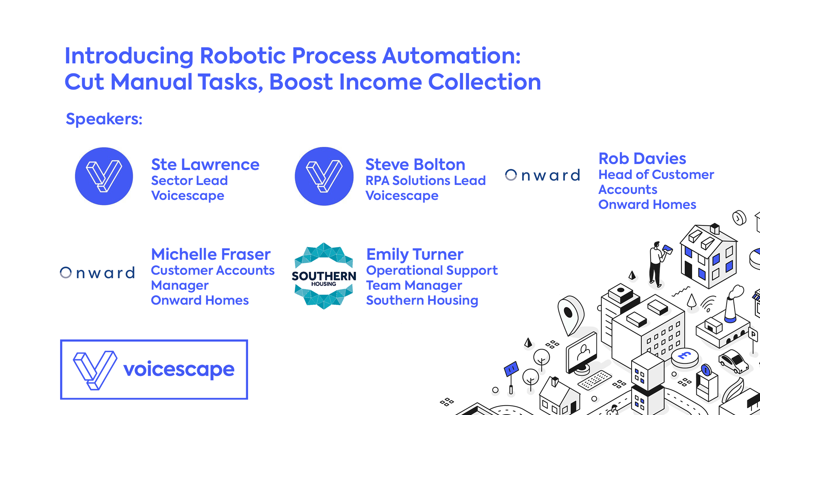

In our latest webinar, “Introducing Robotic Process Automation: Cut Manual Tasks, Boost Income Collection”, we asked attendees: “What is your team’s biggest operational challenge right now?”
Out of 100 responses, 50% cited capacity and workload pressures, while 33% pointed to repetitive, time-consuming tasks, and 6% cited errors - highlighting the growing need for a more efficient and effective approach to handling high-volume, day-to-day processes within the housing sector.
In the webinar, we explored how housing providers are using Robotic Process Automation (RPA) to overcome these challenges - boosting efficiency, accelerating task completion, freeing up capacity for higher-value work, and ultimately, protecting revenue.
Onward Homes and Southern Housing shared how they've transformed operations and delivered measurable impact across Universal Credit Verification, Direct Debit Uplifts, and Housing Benefit Overpayments - including 79,000+ tasks automated, 40,000+ claims processed, and 2.5 FTE years of capacity freed up.
What is Robotic Process Automation (RPA)?
RPA entails the use of “bots” to automate repetitive, high-volume, time-consuming, and rule-based tasks such as data entry and transfer, form processing, logging into systems, moving files or extracting information, etc.
Housing providers are using RPA to automate key processes such as Universal Credit Verification, Direct Debit Uplifts, Housing Benefit Overpayments, temporary accommodation processes, and email inbox management.
As a scalable platform, RPA can be extended across the organisation and adapted to support operational workflows in other areas - with examples including certification compliance, lettings applications, finance invoice processing, and other high-volume administrative processes.
Key Benefits
- Reduced manual workload and operational pressure, freeing teams for higher-value work, such as supporting residents who need it
- Improved accuracy, data quality, and consistency in high-volume processes
- Full audit trails and seamless integration with core systems
- 24/7 processing capacity, including overnight and weekend automation
- Reduced errors, rework, and process variability
- Reductions in costs and protection of revenue
Sector Success: Real-World Impact
Onward Homes and Southern Housing demonstrated how RPA is delivering measurable operational and financial impact, at scale, across key use cases.
1) Onward Homes – Universal Credit Verification & Direct Debit Uplift
Rob Davies, Head of Customer Accounts & Money Advice, shared how Onward Homes transformed Universal Credit Verification (UCV), previously a major operational task due to manual processing and multiple DWP portals.
By implementing an off-the-shelf RPA solution in just weeks, the team automated UCV across multiple systems. Rob shared the measurable impact achieved - including improvements in processing speed, customer care, productivity and freeing up colleague time to focus on providing tailored support, with these key results:
- 40,000+ claims processed
- 8,000+ in the first two months
- 80%+ automation success rate
- £50k+ colleague time savings
Customer Accounts Manager, Michelle Fraser, then shared how this success was extended into Direct Debit Uplifts, replacing complex manual rent updates with a faster, more reliable process:
- 15,000 amendments in 16 days
- ~65% reduction in rent enquiries
- ~£81k in cost savings annually
She highlighted how this improved consistency, reduced risk, and increased transparency - while creating capacity during peak periods and standing as a proof point for wider automation across the organisation.
2) Southern Housing – Universal Credit Verification and Housing Benefit Overpayment
Emily Turner, Operational Support Team Manager, shared how Southern Housing has scaled RPA across several processes, including Universal Credit Verification (UCV) and Housing Benefit Overpayments (HBOP).
She explained how increasing complexity - including multiple DWP portals and legacy systems - made UCV highly resource-intensive, particularly during peak periods. RPA enabled the team to manage this at scale, delivering:
- 70% automation success rate
- 1,300 hours saved annually
- 79,000+ tasks automated
- Equivalent to 2.5 FTE years of capacity freed up
- Plan to upscale in near future to reduce business exceptions, enabling a higher automation rate
Emily also outlined how her team has been able to transform Housing Benefit Overpayments from a reactive, manual, and time-intensive process into an automated, controlled, and scalable operation – delivering the following key results:
- Processing reduced from 10–60 minutes to under 1 minute
- 80%+ automated processing rate
- Zero duplicate or invalid payments
- £75k recovered in 6 months
- £166k processed on time, reducing escalation to blameless recovery
- Plan to upscale to UC Overpayments in the near future
|
Watch the full webinar Click HERE to access a time-stamped recording of the full webinar to share with your team. |
|
Want to discover how RPA could transform your organisation's operations? Book a demo to speak to a member of the team, see the technology in action, and explore how RPA could work for your organisation.
|